Showing posts with label peds. Show all posts

Friday, April 6, 2012

plastic bronchitis

PMID: 22430124
--Do P, Randhawa I, Chin T, Parsapour K, Nussbaum E., Successful Management of Plastic Bronchitis in a Child Post Fontan: Case Report and Literature Review. Lung. 2012 Mar 20. [Epub ahead of print]


QUICK LEARNING POINTS:
--Plastic bronchitis is a rare, potentially fatal, condition noted in patients after Fontan surgery.

--The mucoid impaction with cast formation occludes the major bronchi with firm, gelatinous material. 

--Acute management involves ABCs (airway, breathing, circulation), potentially requiring intubation for respiratory failure. 

--General airway clearance measures with bronchodilators and chest physiotherapy should be initiated.

--In emergent cases, immediate bronchoscopy, whether rigid or flexible, should be considered.  Bronchial casts are unique foreign bodies that may be friable or dissolvable, making lavage a necessary component of its removal.

--While bronchoscopy can be effective for acute therapy, it does not prevent recurrence nor should it be utilized on a chronic basis. 


BOTTOM LINE:
--Plastic bronchitis is a rare, potentially fatal, condition noted in patients after Fontan surgery.
--treatment toolbox: inhaled mucolytics, bronchodilators, intubation & bronchoscopy if necessary


Submitted by J. Gullo.


Reference(s): article, picture

Wednesday, March 14, 2012

Predictors of Pneumonia in Peds ED

Prospective cohort study in urban peds ED with 2574 patients < 21 years old (most < 5 years old)

Looked at history and physical exam findings that correlated with radiographic (i.e. CXR) pneumonia (PNA)
16% of patients had radiographic PNA

Significant predictors of PNA
  • chest pain
  • focal rales
  • fever > 72 hours
  • O2 sat < 92%

Limits of study: not blinded, did not study all patient with cough or fever, do not know reliability of physical exam findings, did not include children who had suspected PNA but did not get a CXR

Take home: There is not a great clinical prediction rule for whether to get CXR on kids with respiratory complaints and fever.

Best of a bad situation: Single best predictor of radiographic PNA in kids < 5 = O2 sat < 92%

Monday, January 30, 2012

Intussusception: quick review

(scroll to bottom for 10-second version)

DEMOGRAPHICS
--most common cause of intestinal obstruction in kids 3 months-6 years of age.
--male:female ratio is 4:1
--Seasonal variation with peaks after GI viral illness seasons.

PATHOPHYSIOLOGY
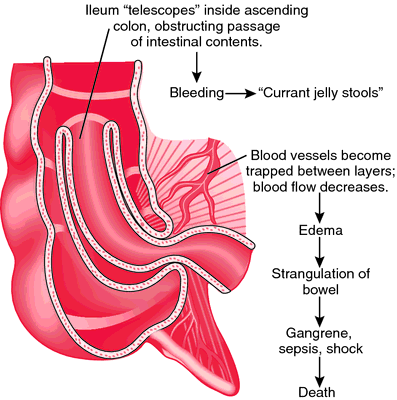
--In younger children, the ileum invaginates into the upper colon, bringing the mesentery with it (ileocolic).
--lead point is often lymphoid hyperplasia from viral gastroenteritis

--In older children, ileo-ileo intussusceptions are more common. 
--lead point causes include intestinal polyps, Meckel diverticulum, lymphosarcoma, or even HSP

--Constriction of the mesentery obstructs venous return, leading to bowel ischemia and bloody stools leading to the classic “currant jelly” stool, which is a late finding occurring in about 50% of cases

CLINICAL FEATURES
--Sudden colicky abdominal pain (child will stop, cry, draw up their legs, and then after a few minutes the child appears well). 
--As the condition progresses the time between episodes decreases.   
--Stool is generally guaiac positive even in the absence of gross blood. 
--A palpable sausage shaped mass can be found on the right side of the abdomen in about 2/3 of cases

DIAGNOSIS
--Diagnosis often made by history alone
--KUB may suggest a filling defect in the right lower quadrant of the abdomen or can be normal
--US can often show the classic target appearance of bowel within bowel (donut sign (transverse); sandwich sign (longitudinal)


TREATMENT
--Air contrast enema is preferred over barium enema because it enables better control over colonic pressure and in the case of perforation prevents barium spillage into the peritoneum.
--Children generally admitted for observation because of the 5-10% recurrence rate.  A second attempt at air reduction is usually successful, but if further recurrences occur surgical reduction may be necessary.  


10-SECOND RECAP:
--most common in kids 3 mo-6 yrs old; male:female 4:1
--ileocolic (younger), ileo-ileo (older), or wherever
--common lead points (lympoid hyperplasia from gastroenteritis, polyps, meckel's, cancer, HSP, etc.)
--bowel ischemia -> guaiac+ stool -> occasionally currant jelly stool
--history is key, palpable sausage in RLQ in 2/3, KUB maybe, ultrasound (donut/sandwich signs)
--air contrast enema = diagnostic + therapeutic; surgery if that doesn't work


Submitted by J. Grover.


Reference(s): Tintinalli's Emergency Medicine, picture 1, KUB, donut, sandwich

Monday, January 16, 2012

Humidified air for treatment of croup: does it work?

WELL, DOES IT?
--Treatment of croup with humidified air is not effective according to multiple studies

--In a JAMA article, 140 children with moderate-severe croup either received humidified blow-by O2, 40% humidified O2 or 100% humidified O2 with no difference found in croup score, treatment with epi or dex, hospital admission, or additional medical care between groups

--Another study of 71 children age 3 months – 6 yrs with moderate croup received either mist stick or no mist for 2 hours showed no difference in croup score, O2 sat, HR or RR between groups

--Some risks of humidified air include scald injuries, dispension of molds and fungus from improperly cleaned mist tents


BOTTOM LINE:
--Treatment of croup with humidified air is not effective in improving vitals or need for further treatment


Submitted by F. DiFranco.


Reference(s):  Bjornson C., Johnson D.W. Croup. The Lancet. 371:329-339, Jan. 2008.; Neto G., Kentab O., Klassen T., Osmond M. A randomized controlled trial of mist in the acute treatment of moderate croup. Academic Emergency Medicine. 9:873-879, 2002.; Scolnik D., Coates A., Stephens D., DaSilva Z., Lavine E., Schuh S. Controlled delivery of high vs low humidity vs mist therapy for croup in emergency departments. JAMA. 295:1274-80, 2006. , picture

Wednesday, January 4, 2012

what's a normal alkaline phosphatase level in children?


QUICK TAKE-AWAY:
--This study linked below analyzed nearly 1700 serum samples from children age 0 – 18.  About 80 of the children had liver disease.  They considered an alk phos of 335 to be the upper limit of normal in childhood.  Most of their data topped out at under an alk phos of 250-ish.

--not sure I can post their figures up without permission, but if you have a minute, click the link, look at figures 1 & 2, figure 2 mainly. picture's worth a thousand words.


Submitted by J. Gullo.


Reference(s): Knight JA, Haymond RE. gamma-Glutamyltransferase and alkaline phosphatase activities compared in serum of normal children and children with liver disease. Clin Chem. 1981 Jan;27(1):48-51., picture