Showing posts with label difranco. Show all posts

Wednesday, March 14, 2012

Predictors of Pneumonia in Peds ED

Prospective cohort study in urban peds ED with 2574 patients < 21 years old (most < 5 years old)

Looked at history and physical exam findings that correlated with radiographic (i.e. CXR) pneumonia (PNA)
16% of patients had radiographic PNA

Significant predictors of PNA
  • chest pain
  • focal rales
  • fever > 72 hours
  • O2 sat < 92%

Limits of study: not blinded, did not study all patient with cough or fever, do not know reliability of physical exam findings, did not include children who had suspected PNA but did not get a CXR

Take home: There is not a great clinical prediction rule for whether to get CXR on kids with respiratory complaints and fever.

Best of a bad situation: Single best predictor of radiographic PNA in kids < 5 = O2 sat < 92%

Thursday, January 26, 2012

brace vs. cast for Salter I & II distal fibula fractures


QUICK OVERVIEW:
--Isolated non-displaced Salter type I & II distal fibula fx’s and avulsion fx’s are very low risk for long-term complications (i.e. growth arrest – no reports found after lit review)

--For an unstable ankle, the ligaments connecting the tibia, fibula and talus must be broken in 2 places; with Salter I/II fibula fx ligament only broken in 1 place

--removable ankle brace (e.g. Air-Stirrup) vs. traditional castsin a non-inferiority RCT single blind study, removable ankle brace patients had...
  • less functional morbidity
  • more rapid return to baseline activity (~80% back to baseline activity with brace in 4 wks, vs ~60% of those with cast)
  • preferred by patient and families
  • more cost-effective

--Can advise parents/patient to expect pain for next 2-4 weeks, full return to competitive sports usually in 6-12 weeks


Submitted by F. DiFranco. 


Reference(s): Boutis, K., et al. A randomized controlled trial of removable brace versus casting in children with low-risk ankle fractures. Pediatrics. 119(6):1256-1263, June 2007; Boutis, K., et al. Common pediatric fractures treated with minimal intervention. Pediatric Emergency Care. 26(2):152-157, Feb. 2010., picture

Wednesday, January 25, 2012

steroids and sore throat

(scroll to bottom for 10-second version)
REVIEW ARTICLE:
--includes 5 adult trials of IM vs oral steroids for acute pharyngitis

--suggested earlier reduction of pain and shorter time to complete relief as well as 3 pediatric trials using oral dex (0.6 mg/kg to a max of 10 mg) as a single dose or given over 3 days showed earlier pain reduction compared to controls

--no benefit to 3 day vs. single dose


META-ANALYSIS:
--includes 8 RCT’s comparing systemic corticosteroids and placebo

--when given with antibiotics, patients who received steroids had an average onset of pain relief 6.3 hours earlier


INTRAMUSCULAR STEROIDS:
--turkish study; single dose IM dex vs. placebo for patients with 2+ Centor criteria

--average onset to pain relief of 8.1 hrs in steroid group vs. 19.9 hrs in placebo group

--complete pain relief of 28.9 hrs (steroid) vs 53.7 hrs (placebo)


PO vs. IM STEROIDS:
--single dose oral prednisone vs IM dexamethasone

--no difference in pain scores or number of hours to relief of pain


10-SECOND RECAP:
--steroids in acute pharyngitis: hastens pain relief by about 6-24 hours (vs. placebo)
--single dose probably just as good as 3-day course
--dexamethasone IM vs. prednisone PO: works about the same


Submitted by F. DiFranco.


Reference(s): Hayward, G., et al. Corticosteroids for pain relief in sore throat: systematic review and meta-analysis. British Medical Journal. 339:b2976, Aug. 2009; Korb, K., et al. Steroids as adjuvant therapy for acute pharyngitis in ambulatory patients: a systematic review. Annals of Family Medicine. 8(1):58, Jan.-Feb. 2010; Marvez-Valls, E., et al. A randomized clinical trial of oral versus intramuscular delivery of steroids in acute exudative pharyngitis. Academic Emergency Medicine. 9(1):1, Jan. 2002; Tasar, A., et al. Clinical efficacy of dexamethasone for acute exudative pharyngitis. Journal of Emergency Medicine. 35(4):363, Nov. 2008; picture

Friday, January 20, 2012

elevated troponin: what if its not an MI?

QUICK REVIEW:
--Myocardial necrosis indicated by elevated troponin is NOT always due to atherosclerotic CAD

--Troponin has high sensitivity for detecting very small amount of myocardial cell death

--Troponin is released in the blood due to irreversible as well as reversible cell damage AND does ≠ permanent myocyte damage


EXPANDED DIFFERENTIAL:
--Demand ischemia: sepsis/SIRS, hypotension, hypovolemia, SVT/afib, LVH

--Myocardial ischemia: coronary vasospasm, ICH/stroke, ingestion of sympathomimetic agents

--Direct myocardial damage: cardiac contusion, ICD shock, cardiac infiltrative d/o (amyloidosis), chemotherapy, myocarditis/pericarditis, heart transplant

--Myocardial strain: CHF, PE, PHTN, COPD, strenuous exercise

--Chronic renal insufficiency


Submitted by F. DiFranco.


Reference(s): Jeremias A. & Gibson M. Narrative review: alternative causes for elevated cardiac troponin levels when acute coronary syndromes are excluded. Annals of Internal Medicine. 142(9):786-791, May 2005.

Thursday, January 19, 2012

ultrasound in testicular torsion

WHAT TO LOOK FOR:


Submitted by F. DiFranco.


Reference(s): www.sonoguide.com; Images from: Adhikari, S.R. MD. Testicular Ultrasound. Fig 5&6. Retreived from http://www.sonoguide.com; Baldisserotto, M. Scrotal emergencies. Pediatr Radiol 2009; 39:516.

Wednesday, January 18, 2012

How to tell a traumatic tap vs. SAH

QUICK REVIEW:
--There is no criteria for how many RBCs in the CSF are needed to diagnose SAH

--One of the best methods to distinguish traumatic tap vs SAH is by looking for xanthochromia

--Can measure xanthochromia by visual inspection (subjective, human error) OR spectrophotometry (very sensitive but not very specific, not widely available at most hospitals)

--Occurs via breakdown of Hgb -> oxyhemoglobin (pink-orange, can happen in vitro) -> bilirubin (yellow, only happens in vivo)


PEARLS:
--False positive xanthochromia can occur from jaundice (usually total serum bili of at least 10-15 mg/dL), rifampin, high CSF protein concentration (>150 mg/dL), or excess carotenoid intake

--Oxyhemoglobin can be present in traumatic tap and appear faintly yellow

--Formation of bilirubin takes time, but after 12 hrs from onset of aneurysm rupture (i.e. “worst HA of my life”), CSF should show xanthochromia in patients with SAH

--Elevated opening pressure (> 20 cm H2O) + bloody CSF strongly suggests SAH

--When all else fails, you may repeat the LP at a higher interspace


Submitted by F. DiFranco.


Monday, January 16, 2012

Humidified air for treatment of croup: does it work?

WELL, DOES IT?
--Treatment of croup with humidified air is not effective according to multiple studies

--In a JAMA article, 140 children with moderate-severe croup either received humidified blow-by O2, 40% humidified O2 or 100% humidified O2 with no difference found in croup score, treatment with epi or dex, hospital admission, or additional medical care between groups

--Another study of 71 children age 3 months – 6 yrs with moderate croup received either mist stick or no mist for 2 hours showed no difference in croup score, O2 sat, HR or RR between groups

--Some risks of humidified air include scald injuries, dispension of molds and fungus from improperly cleaned mist tents


BOTTOM LINE:
--Treatment of croup with humidified air is not effective in improving vitals or need for further treatment


Submitted by F. DiFranco.


Reference(s):  Bjornson C., Johnson D.W. Croup. The Lancet. 371:329-339, Jan. 2008.; Neto G., Kentab O., Klassen T., Osmond M. A randomized controlled trial of mist in the acute treatment of moderate croup. Academic Emergency Medicine. 9:873-879, 2002.; Scolnik D., Coates A., Stephens D., DaSilva Z., Lavine E., Schuh S. Controlled delivery of high vs low humidity vs mist therapy for croup in emergency departments. JAMA. 295:1274-80, 2006. , picture

Monday, December 19, 2011

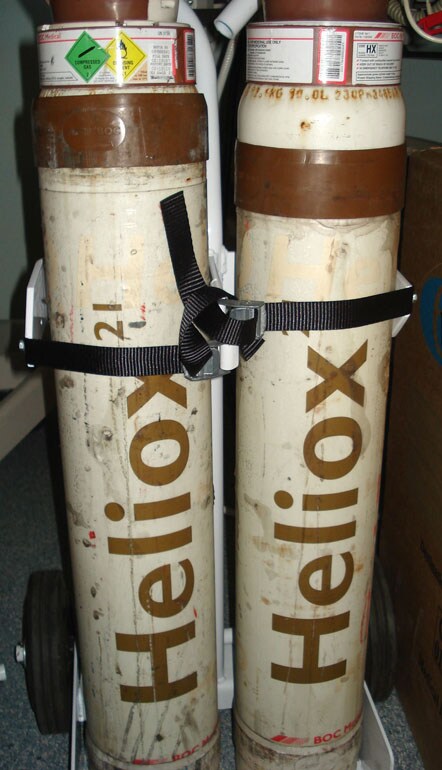
heliox for acute asthma

COCHRANE REVIEW:
--10 small RCT’s (7 adults, 3 children), 544 acute asthma patients comparing inhaled heliox vs placebo (O2, air) in addition to standard treatment found no difference in PFT’s or admission to hospital (1)

--However, in subgroup of patients with severe baseline pulmonary function, heliox did improve PFT so may be some benefit to use in patients w/severe airway obstruction


PEARLS:
--Should be considered after 1st (albuterol, Duoneb, steroid) and 2nd (mag, terbutaline, epi) line therapies fail and patient still has some reserve

--“Heliox-driven albuterol nebulization may be considered for patients who have life- threatening exacerbation or who remain in severe exacerbation after intensive conventional adjunctive therapy” (2)

--Since generally given in mixtures of 70:30 (helium:O2) CANNOT use in patients who are hypoxemic (i.e. need 50% FiO2)

--If the patient needs to be intubated, INTUBATE!


Submitted by F. DiFranco.


Reference(s): (1) i.Rodrigo GJ, Pollack CV, Rodrigo C, Rowe BH. Heliox for non-intubated acute asthma patients. Cochrane Database of Systematic Reviews 2006, Issue 4; (2) Cincinnati Children's Hospital Medical Center. Evidence-based care guideline for management of acute asthma exacerbation in children. Cincinnati (OH): Cincinnati Children's Hospital Medical Center; INFO@GUIDELINES.GOV 2011, picture