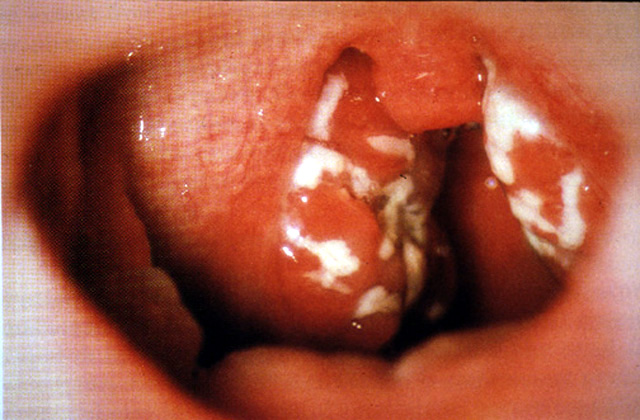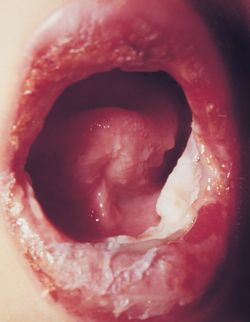
STEVENS-JOHNSON SYNDROME:
--severe idiosyncratic reactions, most commonly triggered by medications, which
are characterized by fever and mucocutaneous lesions leading to necrosis and
sloughing
--less severe disease on the same spectrum as TEN (toxic epidermal necrolysis)
DIAGNOSIS: NOT FAIR
--apparently, you can have Stevens-Johnson syndrome without a rash
PMID: 22041607
The Stevens-Johnson syndrome (SJS) classically involves a
rash, conjunctivitis and mucositis.
case report of isolated mucositis and conjunctivitis.
Previous rare reports of severe
SJS like syndromes without a rash are confined to children, usually with
mycoplasma pnemoniae infection
PMID: 22012144
The commonest
infections associated with SJS have been HSV and Mycoplasma pneumoniae.
Less
than 10% cases of Mycoplasma pneumonia develop extra pulmonary complications
like hemolytic anemia, hepatitis, arthritis, meningitis and SJS.
unclear
from existing literature whether antibiotic treatment of M. pneumoniae infection
decreases the risk for SJS.
PMID: 20678095
another case report of mucocutaneous involvement without skin lesions.
Oral
lesions are present in all cases with SJS associated with M. pneumoniae
infection, ocular lesions only in two-thirds and genital lesions in
three-fourths of all cases.
That SJS in association with M. pneumoniae
infection is predominantly mucosal is reflected by few reports of SJS presenting
without skin lesions. Even when skin lesions are present, mucocutaneous lesions
predominate.
BOTTOM LINE:
--stevens johnson syndrome: skin and mucosal involvement, can progress to sloughing (e.g. TEN)
--can present withOUT rash. Mycoplasma pneumonia is common source.
Submitted by J. Gullo.
Reference(s): uptodate.com: Stevens-Johnson syndrome and toxic epidermal necrolysis: Clinical manifestations; pathogenesis; and diagnosis; article 1, article 2, article 3; picture
Friday, June 8, 2012
Tuesday, June 5, 2012
when not to use succinylcholine
BLATANT REDIRECT:
--check out EMCrit's handy slide
--good quick review of when you can (or can't) use succinylcholine
BOTTOM LINE:
--check out the slide on EMCrit
--if you can't or are lazy, remember succinylcholine causes K+ release
--also, hyperkalemia is bad
--first do no harm
Reference(s): emcrit.org; picture
Monday, June 4, 2012
loop abscess
Looking for a fun and interesting new way to treat an abscess?
(I've done it once, with good success.)
You tube video - only 2 minutes long, worth watching, and worth
reviewing in the ED before actually trying this:
Dr. Tsoriades and colleagues found using a vessel loop (see picture)
was a safe and effective treatment for subcutaneous abscesses in children when
studied in comparison with traditional incision and drainage with packing.
Children in the study were under general anesthesia or conscious
sedation. (I used a traditional field block using 2% lidocaine with epinephrine
in an adult.)
Pros:
- no repeat packing
- better tolerated by patients
- less wound care materials
- much smaller incision - less scarring
Discharge instructions:
- apply warm compresses
- expect drainage
- move loop back and forth 2 times daily
- return if worse/fever/increasing redness
Submitted by S. Morris.
Friday, June 1, 2012
laws of the house of god
--haven't read this in a few years, but came upon this list again recently.
--my favorites are #'s 3 & 6.
--enjoy
- GOMERS DON’T DIE.
- GOMERS GO TO GROUND.
- AT A CARDIAC ARREST, THE FIRST PROCEDURE IS TO TAKE YOUR OWN PULSE.
- THE PATIENT IS THE ONE WITH THE DISEASE.
- PLACEMENT COMES FIRST.
- THERE IS NO BODY CAVITY THAT CANNOT BE REACHED WITH A #14G NEEDLE AND A GOOD STRONG ARM.
- AGE + BUN = LASIX DOSE.
- THEY CAN ALWAYS HURT YOU MORE.
- THE ONLY GOOD ADMISSION IS A DEAD ADMISSION.
- IF YOU DON’T TAKE A TEMPERATURE, YOU CAN’T FIND A FEVER.
- SHOW ME A BMS (Best Medical Student, a student at the Best Medical School) WHO ONLY TRIPLES MY WORK AND I WILL KISS HIS FEET.
- IF THE RADIOLOGY RESIDENT AND THE MEDICAL STUDENT BOTH SEE A LESION ON THE CHEST X-RAY, THERE CAN BE NO LESION THERE.
- THE DELIVERY OF GOOD MEDICAL CARE IS TO DO AS MUCH NOTHING AS POSSIBLE.
Reference(s): thanks, dr. wikipedia; picture
Thursday, May 31, 2012
Antibiotics for MRSA abscesses? NO.
STUDY #1:
Schmitz et al. Randomized Controlled Trial of
Trimethoprim-Sulfamethoxazole for Uncomplicated Skin Abscesses in Patients at
Risk for Community-Associated Methicillin-Resistant Staphylococcus aureus
Infection. Annals of Emergency Medicine, Vol 56, Sept 2010
Bactrim vs. placebo after incision and drainage.
Multicenter, double-blind, RCT in 4 military ED's
outcome: treatment failure after 7 days or reduction of new lesion
formation in 30 days
results:
Tx failure 7 days New lesion
within 30 days
Placebo 26%
28%
TMP/SMX 17%
9%
Difference (95%CI) 9% (-2 to 21%) 19%
(4-34%)
As shown above, there was a significant difference of new lesions in
30 days. only 45% were available at 30 days. big confidence intervals.
STUDY #2
Duong et al. Randomized, Controlled Trial of Antibiotics
in the Management of Community-Acquired Skin Abscesses in the Pediatric Patient.
Annals of Emergency Medicine, Vol 55, May 2010
Bactrim vs. placebo after incision and drainage.
double-bind RCT in pediatric patients
outcome: treatment failure within 10 days (need for second incision,
IV antibiotics, continued erythema, warmth, fluctuance at 10 day follow up).
results:
Failure to improve 10 day new lesions 90 day new
lesions**
Placebo 5.3% 26.4% 28.8%
TMP/SMX 4.1% 12.9% 28.3%
Placebo 5.3% 26.4% 28.8%
TMP/SMX 4.1% 12.9% 28.3%
** Note that only around 60% were effectively followed up at 90
days.
Conclusion: no difference in failure rates with or without
antibiotics.
Of note, in treatment arm, only 46% of patients were compliant with
antibiotics, taking at least half of the pills.
Note that there are many other studies showing that antibiotic use
does NOT eradicate MRSA.
BOTTOM LINE:
Immunocompetent patients with MRSA abscesses can be treated with I
& D alone. Not enough data to support consistent antibiotic use.
Consider addition of antibiotics in diabetics, immunocompromised,
or systemically ill.
Submitted by S. Morris.
Wednesday, May 30, 2012
passive preoxygenation - a radical concept
consider putting them on a nasal
cannula at 15L per min under the NRB.
this article advocates it as a form of "apneic oxygenation"
which can prevent desaturation during intubation.
Awake patients will not
tolerate it at 15L/min, so you can start with 4-5 L and then increase to 15
after giving your induction and paralytic medications.
The point: Apneic oxygenation can extend the duration of safe
apnea.
Note: High O2 could decrease the respiratory drive, but this is for
people who you are committed to intubating already.
I would love to hear your
success stories with this new method!
Submitted by S. Morris.
Reference(s): Weingart, S., Levitan, R. Preoxygenation and Prevention of Desaturation During Emergency Airway Management. Annals of Emergency Medicine. Nov 2011. Vol 9. Iss 3. ; picture
Tuesday, May 29, 2012
steroids for pharyngitis + Centor criteria refresher
STUDY HIGHLIGHTS:
Meta-analysis of 9 RCT's of adults and children using steroids for
tonsillitis or pharyngitis
did find more patients with resolution of pain with
steroids at 24 or 48 hours.
All patients received antibiotics, which may have been
confounding.
BOTTOM LINE:
consider steroids (maybe prednisone 60mg x1 or 2 days)
for adult patients with severe exudative sore throat in conjunction with
antibiotics.
Of course, steroids have complications, so consider them when
prescribing.
Hayward, G. et.al. (2009). Corticosteroids for pain relief in sore throat:
systematic review and meta-analysis. British Medical Journal.
-----
P.S.
a reminder of the Centor criteria (if you believe in them)
The 4 criteria are:
- fever
- pharyngeal exudates
- anterior cervical adenopathy
- absence of a cough.
The presence of a cough, hoarse voice, or
conjunctivitis, suggests a viral etiology and is not considered a risk factor
for group A beta-hemolytic strep.
Centor criteria should not be used to predict
GABS in children.
- <2 points — No antibiotic or throat culture necessary.
(Risk of strep infection <10%) - 2-3 points — Should receive a throat culture and treat with an antibiotic if culture is positive.
- >3 points — Treat empirically with an antibiotic.
(Risk of strep infection >50%)
Singer JI, Gebhart ME: Sore throat, in Marx JA, Hockberger RS, Walls
RM (eds): Rosen's Emergency Medicine Concepts and Clinical Practice, ed 6, St.
Louis: Mosby, 2006: 274
Submitted by S. Morris.
Reference(s): hayward study; rosen's chapter (listed above); picture
Subscribe to:
Posts (Atom)