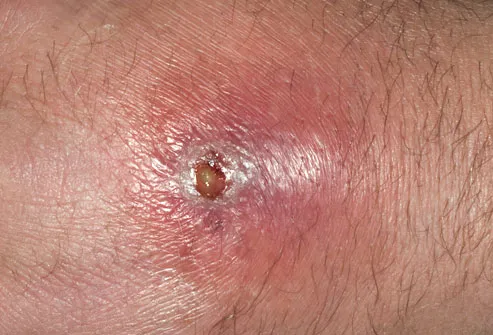
Showing posts with label abscess. Show all posts

Monday, June 4, 2012

loop abscess


Looking for a fun and interesting new way to treat an abscess?
(I've done it once, with good success.)

You tube video - only 2 minutes long, worth watching, and worth reviewing in the ED before actually trying this:


Dr. Tsoriades and colleagues found using a vessel loop (see picture) was a safe and effective treatment for subcutaneous abscesses in children when studied in comparison with traditional incision and drainage with packing. 

Children in the study were under general anesthesia or conscious sedation. (I used a traditional field block using 2% lidocaine with epinephrine in an adult.)


Pros:
  • no repeat packing
  • better tolerated by patients
  • less wound care materials
  • much smaller incision - less scarring


Discharge instructions:
  • apply warm compresses
  • expect drainage
  • move loop back and forth 2 times daily 
  • return if worse/fever/increasing redness


Submitted by S. Morris.


Reference(s): A.P. Ladd, M.S. Levy, J. Quilty. Minimally invasive technique in treatment of complex, subcutaneous abscesses in children. J Pediatr Surg, 45 (2010), pp. 1562–1566;  S.S. Tsoraides, R.H. Pearl, A.B. Stanfill, L.J. Wallace, R.K. VeguntaIncision and loop drainage: A minimally invasive technique for subcutaneous abscess management in children J Pediatr Surg, 45 (2010), pp. 606–609; picture


Thursday, May 31, 2012

Antibiotics for MRSA abscesses? NO.


STUDY #1:
Schmitz et al. Randomized Controlled Trial of Trimethoprim-Sulfamethoxazole for Uncomplicated Skin Abscesses in Patients at Risk for Community-Associated Methicillin-Resistant Staphylococcus aureus Infection. Annals of Emergency Medicine, Vol 56, Sept 2010

Bactrim vs. placebo after incision and drainage.  

Multicenter, double-blind, RCT in 4 military ED's

outcome: treatment failure after 7 days or reduction of new lesion formation in 30 days

results:
                        Tx failure 7 days              New lesion within 30 days      
Placebo                     26%                                          28%
TMP/SMX                  17%                                           9%
Difference (95%CI)      9% (-2 to 21%)                         19% (4-34%)

As shown above, there was a significant difference of new lesions in 30 days.  only 45% were available at 30 days.  big confidence intervals.


STUDY #2
Duong et al. Randomized, Controlled Trial of Antibiotics in the Management of Community-Acquired Skin Abscesses in the Pediatric Patient. Annals of Emergency Medicine, Vol 55, May 2010

Bactrim vs. placebo after incision and drainage

double-bind RCT in pediatric patients

outcome: treatment failure within 10 days (need for second incision, IV antibiotics, continued erythema, warmth, fluctuance at 10 day follow up).

results:
              Failure to improve            10 day new lesions    90 day new lesions**
Placebo          5.3%                         26.4%                     28.8%
TMP/SMX       4.1%                         12.9%                     28.3%
** Note that only around 60% were effectively followed up at 90 days.

Conclusion: no difference in failure rates with or without antibiotics. 

Of note,  in treatment arm, only 46% of patients were compliant with antibiotics, taking at least half of the pills. 

Note that there are many other studies showing that antibiotic use does NOT eradicate MRSA.


BOTTOM LINE:
Immunocompetent patients with MRSA abscesses can be treated with I & D alone. Not enough data to support consistent antibiotic use. 

Consider addition of antibiotics in diabetics, immunocompromised, or systemically ill. 


Submitted by S. Morris.


Reference(s): study 1, study 2, picture

Thursday, March 22, 2012

should we pack an abscess after I&D?

ABSCESS PACKING DATA:
--very limited, based on Pubmed biopsy


REVIEW ARTICLE:
--referenced one small article, and that was it


ONE SMALL ARTICLE:
--"determine whether the routine packing of simple cutaneous abscesses after incision and drainage (I&D) confers any benefit over I&D alone"
--prospective, randomized, single-blinded trial, N =48
  • no significant difference in need for a second intervention at the 48-hour follow-up between the packed (4 of 23 subjects) and nonpacked (5 of 25 subjects) groups (p = 0.72; relative risk = 1.3, 95% confidence interval [CI] = 0.4 to 4.2)
  • higher pain scores immediately postprocedure in packed group and at 48 hours postprocedure
  • greater use of ibuprofen and oxycodone/acetaminophen in packed group 

ABOUT PERIANAL ABSCESSES:
--"designed to show that perianal abscess may be safely treated by incision and drainage alone" vs. I&D + packing
--50 patients were recruited (7 lost to follow-up); 20 in the packing and 23 in the nonpacking arm
  • Mean healing times were similar ( P = 0.214).
  • The rate of abscess recurrence was similar ( P = 0.61).
  • Postoperative fistula rates were similar ( P = 0.38).
  • Pain scores at the first dressing change were similar ( P = 0.296).
  • Although pain scores appeared much reduced in the nonpacking arm, this did not attain statistical significance

BOTTOM LINE:
--limited data out there on packing abscesses
--packing doesn't seem to improve healing or reduce recurrence
--packing might hurt more
--probably ok to NOT pack abscess after I&D


Submitted by S. Lee.


Reference(s): review article, one small article, perianal abscess article, picture