Monday, December 12, 2011

retinal detachment

KEY POINTS:
--can be traumatic or non-traumatic
--often present with 'floaters' in one eye, peripheral visual field defect

--can lead to loss of vision
--need optho consultation, dilated eye exam, may need retinopexy (something I can't do in the ED)


OCULAR ULTRASOUND:
--high-frequency linear (7.5-10 MHz) transducer
--retinal detachment: a prominent, continuous linear density rising from the fundus


Reference(s): uptodate.com: retinal tear and detachment, ACEP Focus on ocular ultrasound for retinal detachment (picture also)

Friday, December 9, 2011

perforated tympanic membrane

HOW DID THIS HAPPEN?
--barotrauma of all sorts (pressure changes with airplanes, diving, etc)
--self-induced/foreign bodies (q-tips, paper clips, etc)
--otitis

WHAT DO I DO?:
--most heal on their own
--antibiotics only if infectious etiology
--antibiotic choice: oral + topical; avoid antiseptic/acidic drops with perf'd TM (e.g. ofloxacin ok, corticosporin NOT ok)
--pain meds
--no evidence for decongestants, antihistimines, steroids

Thursday, December 8, 2011

photokeratitis

WHAT IS IT?
--UV (ultraviolet) keratitis
--UV light damages corneal epithelium
--often presents some time after exposure (latent period 6-12 hours)
--generally self-limited with complete resolution in 1-3 days


COMMON PRESENTATIONS:
--welders
--snowblindness

--bilateral eye pain, injection, photophobia, foreign body sensation
--can have associated facial erythema/edema


MANAGEMENT:
--analgesics (photokeratitis hurts)
--antibiotic ointments (prophylaxis and lubrication)
--optho follow-up
--advise proper protective eyewear


10-SECOND RECAP:
--photokeratitis=corneal epithelial damage from UV light
--often from welding, snowblindness
--bilateral pain, photophobia, injection; often presents after a 6-12 hr latent period
--treatment toolbox: pain meds, antibiotic oinments, optho follow-up, better goggles


Reference(s): uptodate.com: photokeratitis, photo

Tuesday, December 6, 2011

hypotension and valvular dysfunction: chicken or the egg?

CASE PARTICULARS:
--SOB, hypotension
--labs notable for slightly elevated troponin, AKI


DIAGNOSTICS:
--could not undergo CTPA to r/o PE due to AKI
--ECHO in ED shows no RV dilation but did show severe MR and TR.
--pt intubated secondary to massive fluid resuscitation

--ECHO following day was normal. 
--Once rehydrated, pt did much better.  No PE was found on CTPA.

WHAT HAPPENED?
--hypovolemia exacerbated systolic anterior motion of mitral valve causing severe dynamic MR and TR, causing cardiogenic shock. 

TEACHING POINTS:
--This patient had LV outflow tract obstruction by a hyperdynamic anterior motion of the mitral valve leaflets during systole, causing a severe mitral regurgitation due to the blockage of the outflow tract as well as opening of the mitral valve during systole. 
--This mimics HOCM, but was in a structurally normal heart. 
--Obstructive physiology, and especially systolic anterior motion of the mitral valve, can be caused by various disorders including hypercontractile states such as hypovolemia, anemia, beta agonist drugs, D-transposition of the great arteries, congenital/acquired abnormalities of the mitral valve/papillary muscles, and immediately after aortic valve surgery for aortic stenosis (due to acute afterload reduction).

10-SECOND TAKEAWAY:
--suspect massive PE, can’t to CTPA, think of bedside echo to look for RV dilation/strain
--severe hypercontractile states (e.g. hypovolemia) can result in obstructive physiology, including valvular dysfunction
--can be transient, should improve with fluids (good idea for treatment)

Submitted by T. Boyd.

Refence(s): Rosen B et al. “Hypovolemia-Induced Reversible Severe Mitral Regurgitation Due to Left Ventricular Outflow Tract Obstruction.” Echocardiography. 19:8; Nov. 2002.

Friday, December 2, 2011

acute appendicitis: how good are your diagnostic skills?

AAFP REVIEW ARTICLE KEY POINTS:

COMMON SYMPTOMS (frequency in %):
  • abdominal pain ~100%
  • anorexia ~100%
  • nausea 90%
  • vomiting 75%
  • pain migration 50%
  • Classic symptom sequence (vague periumbilical pain to anorexia/nausea/unsustained vomiting to migration of pain to right lower quadrant to low-grade fever) 50%

SYMPTOM/SIGN (positive likelihood ratio--increased likelihood you have an appy if you have this):
  • RLQ pain (8.0)
  • pain migration (3.2)
  • pain before vomiting (2.8)
  • anorexia, nausea & vomiting (<2.8)
  • psoas sign (2.38)
  • rebound tenderness (variable, 1.1 to 6.3)
  • fever (1.9)

IMAGING:
  • ultrasound: sensitivity 85%, specificity 92%
  • CT: sensitivity 90-100%, specificity 95-97%

BOTTOM LINE:
--most common: abd pain, anorexia, nausea/vomiting, migratory pain
--most useful: RLQ pain, migratory pain, pain before vomiting
--ultrasound is pretty accurate, CT is really accurate, but neither are perfect
--none are truly absolute, think of appy, but also think past appy

Reference(s): AAFP review on appendicitis, tangential craziness

Thursday, December 1, 2011

haldol and QTc

RAGING HYPOTHETICAL:
--You are working overnight and get called about an elderly lady who is agitated. Your patient has IV access and the nurse wants to know what to give. What do you order?

HALDOL (one option):
--can prolong QT interval; should be avoided if QTc is already prolonged
--Haldol is actually FDA approved for IM, not IV. (but we use it IV all the time)
--peaks in the serum in about 20min

OTHER OPTIONS:
--Seroquel is a good PO option (consider 12.5 mg or 25 mg)

--Ativan can worsen delerium (avoid if possible, especially in elderly)

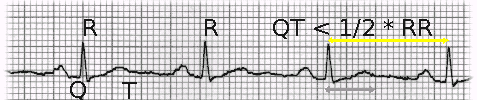
QT  FACTOIDS:
--normal QTc is less than or equal to ~440ms (males borderline long at 431-450, females 451 to 470)
--  >450 is abnormal for males and >470 is abnormal for females.
--the QT interval can be prolonged with hypoKalemia, low Mg, or hypothyroidism (and many, many drugs)
--remember Bazett's formula (or look it up)

QTc=QT⁄√RR


--cheater's way: QTc should be less than 1/2 of the R-R interval.


10-SECOND RECAP:
--agitation tx options: haldol, seroquel, ativan
--haldol can prolong QT, as with MANY other drugs
--QTc=QT⁄√RR   (or 1/2 the R-R interval)
--normal QTc is less than 440ms(ish)

Submitted by R. Morris.

Reference(s): uptodate: haldol, picture

Wednesday, November 30, 2011

Angioedema (quick review)

WHAT IS IT?:
--soft tissue swelling, from the release of inflammatory mediators that cause dilation and increased permeability

--affects head/neck commonly (mouth/tongue/throat is bad for airway); bowel wall causing abdominal pain.

--generally develops over minutes to hours and resolves in 24 to 48 hours

CAUSES:
--allergic/mast cell mediated

--hereditary/Deficiency of C1 (complement protein) inhibitor

--drug related (classically ACE inhibitors , but seen with other meds too—e.g. ARBs, NSAIDs, aspirin, calcium channel blockers)
--rare: occurs in only 0.1 to 0.7 percent of patients treated with an ACE inhibitor; half these cases within 1 week of starting the med, but can occur years later;

--38% idiopathic (no trigger identified)

TREATMENT TOOLBOX:

--ABC’s

--stop the drug (if ACE inhibitor related, etc)

--allergic reaction meds: antihistamines, steroids, epinephrine (efficacy not proven, may not work if not mast cell mediated)

--FFP (fresh frozen plasma) a possibility (complement?)


10-SECOND VERSION:
--angioedema: things swell; airway swelling = not awesome
--from allergic reaction, complement deficiency, ACE I's or other drugs, or idiopathic
--treatment options: airway, antihistamines, steroids, epi, FFP