Showing posts with label ob/gyn. Show all posts

Wednesday, May 16, 2012

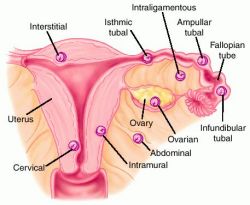
fallopian tube torsion


WHAT IS FALLOPIAN TUBE TORSION?
Twisting of the fallopian tube on itself -- similar to closed loop bowel obstruction

Ovarian torsion is more of an end tube twist, Fallopian tube torsion is proximal to ovarian torsion

Much more rare cause of LQ abd pain/pelvic pain than ovarian torsion
                Prevalence: one in 1.5 million women
                Population at risk: pre-menopausal women, 80% are <50 yo


Risk factors: Most commonly benign etiology (89%)

                Intrinsic factors:  long mesosalpinx, tortuous dilated tube (hydro- or hemato-salpinx), tubal mass, tubal ligation, PID, abnormal peristalsis/periovulatory spasm

                Extrinsic factors:  adhesions, adnexal venous congestion, adjacent ovarian or paraovarian masses, uterine masses, gravid uterus, trauma, sudden body position changes (Sellheim theory)

Proposed mechanism: Mechanical obstruction of adnexal veins/lymphatics --> pelvic congestion/edema --> enlargement of fimbrial end --> partial/complete torsion of tube


                Since vascular supply to adnexa comes from ovarian + uterine vessels --> can get isolated tubal necrosis w/o ovarian vascular compromise


DDx: ovarian torsion, ruptured ovarian cyst, PID, ectopic, appy, urolithiasis, cystitis, SBO/perf

Difficult diagnosis -- non-specific findings, pain is only universal feature


Clinical presentation

Sudden onset lower quadrant abdominal pain / pelvic pain
                May be more intermittent than ovarian torsion (53% had previous attacks of undx’d abd pain)

Slightly more common on the right (3:2 R:L)
Labs: Leukocytosis is mild, and late finding (>24 hrs after onset) -- tube likely unsalvageable

Ultrasound findings

Normal ovaries + uterus with normal blood flow

Free pelvic fluid

Dilated adnexal tubular structure that flares at one end, with thickened echogenic walls, suspicious for hydrosalpinx

A beaked, tapering appearance of the tube, with its vertex pointing toward the affected adnexa

Internal debris/convoluted echogenic mass, which may represent thickened torsed tube

Difficult to visualize vascular compromise of tubal wall

CT findings

Adnexal mass, twisted appearance to fallopian tube, dilated tube >15 mm, thickened enhancing tubal wall, luminal attenuation >50 H c/w hemorrhage

Free pelvic fluid, peritubular fat stranding, enhancement + thickening of broad ligament, regional ileus


Treatment options

Surgical detorsion, salpingotomy

Salpingectomy frequently performed 2/2 irreversible damage


Submitted by S. Eucker.


Reference(s): Gross, M et al, “Isolated Fallopian Tube Torsion: A Rare Twist on a Common Theme”, AJR 2005; 185: 1590-1592.  (Also the reference for the images); Ho, P et al, “Isolated Torsion Of The Fallopian Tube: A Rare Diagnosis In An Adolescent Without Sexual Experience” Taiwan J Obstet Gynecol 2008; 47(2):235-237. Ferrera, P et al, “Torsion of the Fallopian Tube”, Am J Emerg Med 1995; 13:312-314. Weir, CD and Brown, S, “Torsion of the Normal Fallopian Tube in a Premenarcheal Girl: A Case Report”, J Pediatr Surg 1990; 25(6):685-686.

Monday, April 9, 2012

fear the low quantitative hCG

CONCERNED FOR ECTOPIC PREGNANCY?
--first trimester, vaginal bleeding, abdominal pain
--fear the low quant.


STUDY:
--by Kohn et al in 2003 from Acad EM
--looked at beta HCG levels in normal and abnormal early pregnancies
  • 730 ED pt's (retrospective chart review)
  • 253 abnormal IUP (mostly miscarriage)
  • 381 normal IUP
  • 96 Ectopics 

--Abnormal IUP and ectopic pregnancies had similar low beta HCG levels.

--Patients with HCG <1500 were twice as likely to have ectopic pregnancy (LR 2.24).
  • 42% of the ectopics had HCG <1500
  • only 7% of the normal IUP's had HCG <1500

BOTTOM LINE:
--Remember that the descriminatory beta HCG for TV US is >1500, making early pregnancy vs.ectopic with unclear ultrasound a tough decison without surgical pathology.
--HCG <1500 but non-diagnostic ultrasound, fear the ectopic
--stable patient: typical course of action is repeat HCG in 48 hrs
--unstable/borderline patient: have a low threshold of suspicion for ectopic

SCARY PARTING THOUGHT:

Submitted by S. Morris.

Reference(s): study, case report, picture 

Tuesday, April 3, 2012

urine pregnancy test using whole blood

NEAT IDEA:
--case report (link in references)

--drop of blood applied to urine HCG point-of-care test

--tested positive in the unstable ruptured ectopic patient who couldn't pee just then


BOTTOM LINE:
--patient can't/won't pee, try some blood on the urine pregnancy test

--don't know if there's any potential for false +, but in a pinch with a crashing patient, might be worth a shot


Submitted by S. Lee.


Reference(s): article, picture

Tuesday, November 29, 2011

how to counsel patients with miscarriage

WHY IT MATTERS:
--We see so many pt's in ED who come with first trimester vaginal bleeding.
--For us, it is an easy workup, basically, our question is ectopic or not...
--...but for them, the question is: Is there anything I could have done, or that the doctors can do to save the pregnancy?
 
KEY POINTS:
--Studies show, nothing helps:
  • not steroids
  • not pelvic rest
  • not bed rest
  • not beta HCG injections
  • not horomnes (progestogen)
  • not anticoagulation
--So, you can reassure your patients that nothing they did caused this, and there is nothing they can do to make it go on to a successful pregnancy or not. It will just do what it will do. If first trimester pregnancy does result in miscarriage, often these are chromosomal abnormalities (about 57%).

--Fortunately, if you can see an IUP on ultrasound with fetal cardiac activity, 85% of these women with early pregnancy and vaginal bleeding or abdominal pain will carry to full term.

--Heavy bleeding (more than regular menses) is associated with higher pregnancy loss, but spotting is likely to go on to a normal pregnancy.


10-SECOND RECAP:
--first trimester bleeding: ddx starts with ectopic, then miscarriage (threatened or otherwise)
--spotting is better than heavy bleeding
--reassure patients that there's nothing to do, its not their fault; not much really seems to change outcome (miscarriage vs. not)
--reassure patients with ultrasound: +IUP with fetal cardiac activity, 85% will carry to term

Submitted by R. Morris.  

Thursday, October 6, 2011

Postpartum Preecclampsia

Key Points:

--Postpartum preeclampsia = HTN and proteinuria after delivery

--can occur up to 4 weeks after delivery (median of 5 days in this study)

--33-69% of patient have no evidence of preeclampsia in the ante/peripartum period

--HPI: most common complaints (n=22):
  • headache (82%, 18/22)
  • visual changes (31 %)
  • elevated BP at home (23%)
  • nausea (18%)
  • abdominal pain (14%)
  • vomiting (14%)
  • edema (9%)
  • neck pain (9%)

--PHYSICAL EXAM & LABS: notable findings, some not as 'classic' as you think (n=22 unless indicated)
  • elevated SBP (95%)
  • elevated DBP (77%)
  • hyperreflexia (47%, 10/21)
  • edema (84%, 16/19)
  • proteinuria (64%)
  • elevated LFTs (41%)
  • hyperuricemia (54%)

--TREATMENT:
  • BP control (e.g. hydralazine, labetolol)
  • magnesium, benzodiazepines if seizures

10-SECOND TAKEAWAY:
--Postpartum preecclampsia (classically) = HTN, proteinuria, <4wks postpartum
--Symptoms: high BP, HA, vision changes, nausea/vomiting, swelling
--Good to check (but all don't have to be abnormal): BP, reflexes, urine (proteinuria), LFTs, uric acid
--Treatment Toolbox: can't deliver postpartum, so BP control and magnesium/benzos if ecclamptic

Reference(s): Yancey et al. Postpartum Preeclampsia: Emergency Department Presentation and Management. JEmergMed 2008.

Submitted by T. Boyd.